The Roofing Contractor Follow-Up System That Closes More Jobs
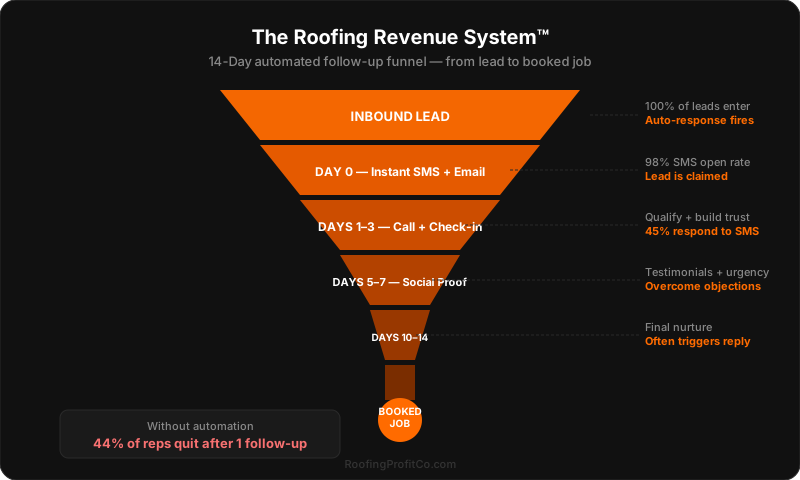
The Roofing Revenue System™ — 14-day automated follow-up funnel
Here's one of the most cited statistics in sales, and it applies directly to your roofing business: 80% of sales require at least five follow-up attempts after the initial contact. Yet 44% of salespeople give up after just one follow-up. In roofing, most contractors follow up once or twice, then move on.
That means the majority of your qualified leads — people who asked for a quote, toured your website, even had an estimate — are being handed to whoever follows up consistently. Which is probably your competitor. The one with the automated system running while they're on a roof in Clearwater.
Why Manual Follow-Up Doesn't Scale in a Roofing Business
Manual follow-up works when you have one or two leads a week and plenty of office time. It breaks down the moment you're running crews, dealing with suppliers, managing insurance claims, and trying to close active jobs. There's no time to track who needs a call, who got an email yesterday, who ghosted you after the estimate.
This problem starts even earlier — at the moment the lead comes in. If you're not responding within the first few minutes, most leads are already gone before follow-up even matters. Read our guide on why 5-minute lead response wins roofing jobs to understand why speed is step one.
The result: inconsistent follow-up that looks something like "call once, leave a voicemail, send one email a few days later, then mentally write the lead off." That's not a system. That's hoping.
And SMS — which has a 98% open rate — gets sent maybe once, if at all, because manually texting individual leads feels uncomfortable and time-consuming.
The 14-Day Follow-Up Sequence That Works
What follows is the actual sequence we build into every RoofingProfitCo Growth and Scale client. It runs automatically from the moment a lead comes in. Your only job is to answer the phone.
Day 0 — Instant (within 30 seconds of form submission):
SMS: Personalized instant response ("Got your request, calling you in 2 minutes..."). Email: Welcome email with your company info, licensing, and link to your Google reviews. This is the critical first touch — sets the professional tone before your competitors have even seen the lead notification.
Day 1 — Follow-up call + voicemail script:
If no contact was made on Day 0, an automated task fires reminding you (or your sales rep) to call. If no answer, a pre-recorded voicemail drops — personalized with their name and your callback number. Follow this immediately with an SMS: "Hey [Name], just left you a voicemail — trying to reach you about your roofing request. Best time to reach you?"
Day 2 — Email follow-up:
A soft-touch email asking if they have any questions about their project. Include a link to 2–3 before/after photos from similar jobs in their area. Build credibility, not pressure.
Day 3 — SMS check-in:
Short and direct: "Hi [Name], this is [Company] — still trying to connect about your roof. Are you still looking for a contractor? Happy to answer any questions." Simple. No pressure. Easy to respond to.
Day 5 — Email with social proof:
Send a testimonial or case study. "Here's what one of our recent customers in [their city] said after their re-roof..." Link to your Google reviews. This touchpoint is about trust-building, not closing. The goal is to stay top of mind as they continue evaluating options.
Day 7 — SMS with soft urgency:
"Hey [Name] — just checking in one more time. We've had a couple of openings come up for next week in [their area]. Would that work for a quick look at your roof?" Creating real, plausible urgency (not manufactured scarcity) moves people off the fence.
Day 10 — Final email:
"We've reached out a few times and haven't been able to connect — completely understand if you've moved in a different direction. If you'd ever like to revisit getting an estimate, we're here." This "breakup" tone often generates a response from leads who were just busy and had forgotten about you.
Day 14 — Breakup text:
"Hey [Name], I won't keep reaching out after this, but if you ever need a roofer in [City], give us a call. We'd love to earn your business." Clean close. Leaves the door open permanently without pestering anyone.
Why SMS Outperforms Email at Every Stage
Email open rates in home services hover around 20%. SMS sits at 98%, with most messages read within 3 minutes of delivery. For roofing specifically — where customers are often dealing with damage, insurance claims, and urgency — SMS creates a direct, personal line that email can't replicate.
The sequence above has 8 touchpoints. Every one of them is automated. Your customer never feels spammed because there's always a real reason to reach out, and the tone stays warm and professional throughout.
What This Looks Like in Practice
A roofing contractor in Orlando signs up. In their first month, they get 34 inbound leads. Before automation, they were following up with maybe 15 of those (the rest fell through the cracks). With automation, all 34 get the full 14-day sequence. They end the month with 6 booked jobs from leads they would have previously never converted, averaging $14,000 each. That's $84,000 in revenue from a follow-up system that ran on its own.
This isn't a hypothetical. It's what happens when you stop relying on manual follow-up and start running a real system.
Our Growth package includes the full 14-day automated follow-up sequence, integrated with your website and CRM. You get the leads, you get the automation, and you get a monthly report showing exactly how many leads came in and how many converted.
The Complete 14-Day Sequence at a Glance
| Day | Channel | Message Type | Primary Goal |
|---|---|---|---|
| Day 0 (Instant) | SMS + Email | Instant response | Set expectation, claim the lead before competitors |
| Day 1 | Call + Voicemail | Follow-up call | Make live contact, qualify the job |
| Day 2 | Credibility email | Build trust with portfolio + license info | |
| Day 3 | SMS | Check-in text | Re-engage, invite a reply |
| Day 5 | Social proof | Overcome objections with testimonials | |
| Day 7 | SMS | Urgency text | Create scheduling momentum |
| Day 10 | Breakup email | Final nurture — often triggers a response | |
| Day 14 | SMS | Breakup text | Close the loop, leave door open permanently |
SMS vs. Email: By the Numbers
| Metric | SMS | |
|---|---|---|
| Open Rate | 98% | 20–25% |
| Average Read Time | Under 3 minutes | Hours to days |
| Response Rate | 45% | 6% |
| Best Use Case | Urgent follow-ups, check-ins, scheduling | Credibility content, portfolios, detailed info |
| Cost Per Send | ~$0.01–0.02 | ~$0.001–0.005 |
The takeaway: use SMS to get attention, email to build credibility. Both channels in tandem outperform either one alone.
What Kills Follow-Up (And How to Avoid It)
Most roofing contractors don't fail at follow-up because they don't care. They fail because of predictable, fixable mistakes:
- Giving up after 1–2 attempts. The data says 80% of sales happen between the 5th and 12th contact. If you're stopping at two, you're quitting before the job even starts. Automation solves this — it keeps following up even when you forget.
- Sending the same generic message each time. "Just checking in!" is the most ignored phrase in sales. Every touchpoint in the sequence has a different angle — social proof, urgency, credibility — so each message feels like a new reason to respond.
- Wrong timing. An 8am Sunday text blast annoys people. The sequence times messages for Tuesday–Thursday, mid-morning or early afternoon — when homeowners are most likely to be responsive. Timing is built into the automation.
- No CRM to track lead stage. Without a CRM, you have no idea who's been contacted, what they said, or where they are in the decision process. GoHighLevel tracks every interaction — calls, texts, emails — in one timeline per lead.
- Treating all leads the same. A homeowner with active storm damage and an open insurance claim is not the same as someone casually researching a re-roof for next spring. The system tags leads by source and urgency so the right message goes to the right person.
Frequently Asked Questions
Won't leads find this annoying?
Leads find irrelevant, generic messages annoying. A sequence that's well-written, professionally timed, and provides value at each touchpoint feels like attentive customer service — not spam. The key is that every message in the sequence has a reason to exist: a credential, an opening in your schedule, a testimonial. When leads do respond, it's often to say "sorry I've been busy, let's set something up."
What if the lead tells me to stop contacting them?
The system handles opt-outs automatically. If a lead replies "STOP" to any SMS, they're immediately removed from1 all automated sequences and flagged as opted out in the CRM. This is both legally required (TCPA compliance) and already built into GoHighLevel's messaging platform.
Can I customize the messages?
Absolutely. Every message in the sequence is written specifically for your company, your service area, and your brand voice during our onboarding process. We don't use generic templates — we write copy that sounds like you. You review and approve the full sequence before it goes live.
What's a realistic close rate improvement?
Contractors who move from1 no follow-up system to a structured 14-day automated sequence typically see their lead-to-booked-job rate improve significantly. The exact number depends on your market, your pricing, and how quickly you make the callback calls. But if you're currently following up with half your leads and closing 10–15% of them, reaching 100% of leads and following up consistently will move that number.
Want This System Built for You?
We build and run the full lead follow-up automation for Florida roofing contractors. Book a free strategy call to see what this looks like for your business.
Book Your Free Strategy Call