How to Get More Google Reviews for Your Roofing Company (Without Begging)
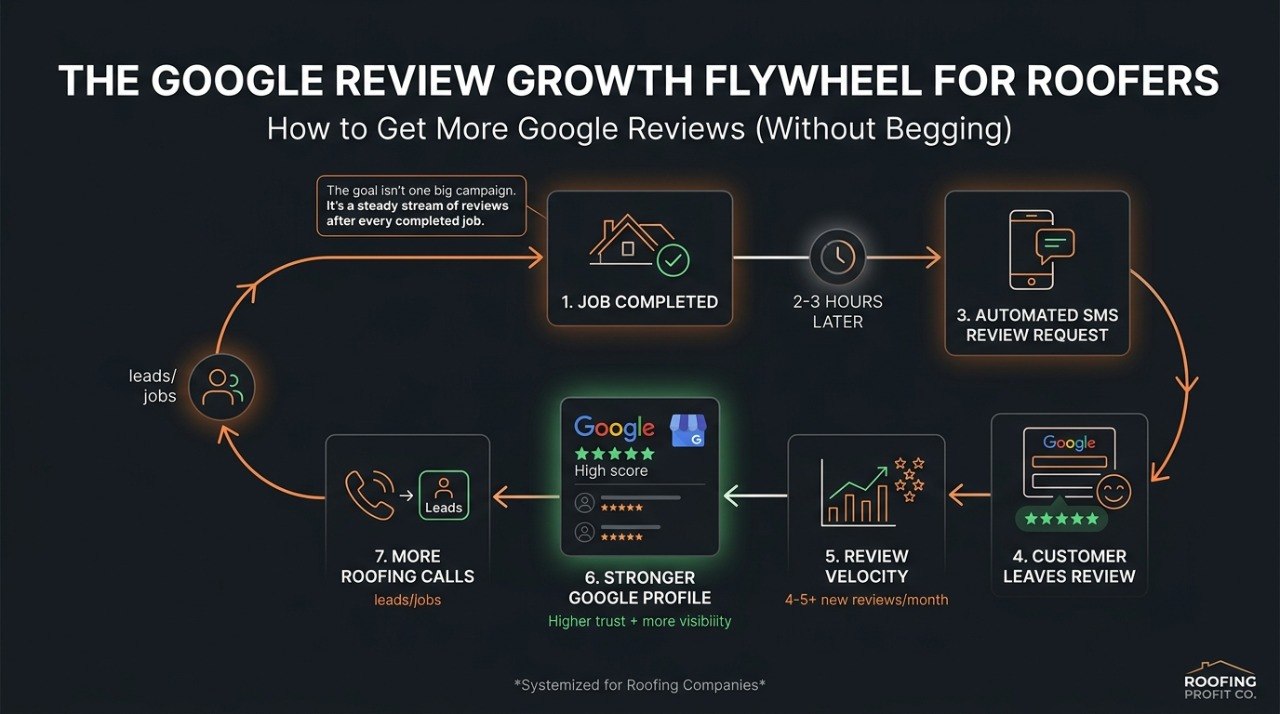
The Google Review Growth Flywheel — how to get more Google reviews without begging
Pull up Google Maps right now and search "roofing contractor [your city]." Look at the top three results. I'll bet at least two of them have 4.5 stars or higher with 50, 80, maybe 150+ reviews. Now look at your listing.
If there's a gap, that gap is costing you jobs every single day — not because your work is worse, but because reviews are the #1 trust signal homeowners use when choosing a roofer. This post is about closing that gap with a system, not with hope.
Why Google Reviews Are the Most Valuable Asset a Roofer Can Build
Google Business Profile (GBP) reviews do three things simultaneously that nothing else can match:
- They boost your local search rankings. Review count, rating, and recency are confirmed ranking factors in Google's local algorithm. More reviews = higher pack placement = more eyeballs.
- They convert cold traffic into calls. A homeowner who finds you through Google is already shopping. A 4.8-star rating with 80 reviews closes the deal before you ever pick up the phone.
- They build trust that no ad can buy. Ads say you're good. Reviews prove it. Homeowners know the difference.
If you're running paid ads without a strong review profile, you're paying for traffic to land on a listing that doesn't convert. Sort out your reviews before you scale your ad spend. And if your website isn't converting visitors into leads in the first place, read our guide on why Florida roofers lose jobs without a real website. See our Growth package — it includes automated review generation alongside your website and lead system.
The Psychology of Why Customers Don't Leave Reviews on Their Own
Here's a contractor's common frustration: "I just did a $22,000 re-roof and the customer literally told me it was the best contractor experience they'd ever had. No review."
This isn't ingratitude. It's human nature. Leaving a review requires effort, and unless someone was genuinely angry (and motivated by that anger), the activation energy to sit down, open Google, find your listing, and write something doesn't exist in most people's daily routine.
But research consistently shows that 70–80% of customers will leave a review if asked at the right moment, in the right way. The problem isn't customer satisfaction. The problem is the ask.
The Right Moment: 2–3 Hours After Job Completion
Timing is everything. Ask too soon (while they're still watching your crew work) and it feels presumptuous. Ask a week later and the emotional high of a finished, beautiful roof has faded — now they're back to thinking about their mortgage, their kids, whatever.
The sweet spot is 2–3 hours after job completion. Your crew has cleaned up and left. The homeowner has walked around, seen the finished product, and is feeling great about the decision they made. They're still in that post-purchase satisfaction window.
That's when an automated text fires:
A direct link to your Google review form removes all friction. They don't have to search for your business, find the right listing, or click through multiple pages. One tap, straight to the review box.
Review Velocity Matters More Than Total Count
Here's something most contractors don't realize: Google weights recent reviews heavily. A contractor with 12 reviews — all from 3 years ago — ranks below a competitor with 30 reviews earned over the last 12 months, even if the older contractor has a higher average rating.
This means a consistent drip of new reviews (even 4–5 per month) beats a one-time burst. Build a system that generates reviews after every job, and your review profile compounds over time. Twelve months from now, you're the contractor with 60+ reviews and a 4.8 rating that dominates your local market.
What To Do About Negative Reviews
Every roofing company gets a bad review eventually. A difficult customer, a miscommunication, a legitimate mistake. Here's how to handle it without making it worse:
- Respond publicly, within 24 hours. Your response is for future customers reading the review, not just the person who left it. Keep it professional and empathetic.
- Don't argue or get defensive. Even if the review is unfair, an argumentative response damages you more than the review itself.
- Offer to resolve it offline. "I'm sorry to hear about your experience — please call us directly at [number] and we'll make it right." This shows accountability without airing grievances publicly.
- Bury it with positives. One 2-star review among 50 5-star reviews is a rounding error. Keep generating positive reviews and the outlier becomes irrelevant.
The Competitive Reality in Florida
In every major Florida market — Tampa, Orlando, Jacksonville, Fort Lauderdale — there are roofing contractors who've figured this out. They have 100+ reviews, a 4.8 rating, and they're showing up first in map results for every storm-season search.
They're not better at roofing than you. They just built a better system for capturing proof of that.
The gap between "3.9 stars, 14 reviews" and "4.8 stars, 90 reviews" is almost entirely about having a review-generation system running after every job. It's not about being better. It's about being systematic.
That's what RoofingProfitCo's review automation system does — it runs automatically, every time you complete a job, and it drives the review velocity you need to climb and hold the top spots in your market.
What Google's Algorithm Actually Looks At
Most contractors think reviews are just about star rating. Google's local ranking algorithm is more nuanced. Here are the five signals that actually move the needle:
- Review Count. Volume matters. More reviews signal an active, legitimate business. Google rewards businesses that consistently earn new reviews over those with a one-time burst from years ago.
- Star Rating. 4.0 is the floor. Below that, click-through rates drop sharply. 4.7–5.0 is the sweet spot — high enough to signal quality, realistic enough to signal authenticity.
- Review Recency & Velocity. A review earned last week counts more than one from 18 months ago. Google rewards businesses with a steady, ongoing stream of new reviews — not a spike followed by silence.
- Response Rate. Google tracks whether you respond to reviews. Businesses that respond to 100% of reviews (positive and negative) rank higher than those that ignore them. Responses also signal active ownership.
- Keyword Mentions. When customers naturally mention your services in their reviews ("roof replacement," "storm damage," "insurance claim") it reinforces your relevance for those searches — without you doing anything.
The Three Templates That Actually Work
The wording of your review request matters almost as much as the timing. Here are three proven SMS templates for roofing contractors:
Template 1: Post-Job Completion
Template 2: Post-Estimate (Didn't Close Yet)
Template 3: Insurance Job Completion
What a Strong Review Profile Actually Changes
| Metric | Under 20 Reviews | 50+ Reviews, 4.7+ Stars |
|---|---|---|
| Google Map Pack Visibility | Rarely appears in top 3 | Consistently in top 3 for local searches |
| Click-Through Rate | ~3–5% of search impressions | ~12–18% of search impressions |
| Phone Call Conversion | Low — rating creates hesitation | High — social proof removes friction |
| Average Job Value Won | Customers negotiate harder | Customers more likely to approve larger scopes |
| Monthly Lead Volume | Dependent on referrals | Steady inbound from Google search |
From 11 Reviews to 94 Reviews in 8 Months
A roofing contractor in the Tampa Bay area came to us with 11 Google reviews and a 4.1-star rating. Good work, loyal customers — but invisible online. Here's what changed:
Month 1–2: System setup and crew training. We installed automated post-job SMS review requests. Every completed job triggered a text 3 hours after crew departure. We also trained the crew foreman to verbally mention the review request at job closeout — "Hey, you'll get a text from us in a few hours, it would mean a lot if you left us a review."
Month 2: The catch-up campaign. We sent a one-time review request to the previous 18 months of completed customers. Of ~200 past customers contacted, 28 left reviews. That single campaign jumped them from 11 to 39 reviews in three weeks.
Months 3–8: Steady velocity. With the automated system running, they averaged 7–9 new reviews per month from ongoing jobs. By month 8: 94 reviews, 4.8-star rating.
The result: They moved from outside the local map pack to the #2 position for "roofing contractor Tampa" — without any paid ads. Inbound calls increased significantly. The review profile became their most powerful sales asset.
Frequently Asked Questions
Can I ask customers to leave a 5-star review specifically?
No — Google's terms of service prohibit "review gating" and soliciting specific ratings. You can ask customers to leave an honest review and make it easy to do so. But you can't say "please leave us 5 stars." The templates above are compliant: they ask for an honest review with no mention of a specific rating.
What do I do if a competitor leaves a fake review?
Flag it through your Google Business Profile dashboard (Report Review). Google's guidelines prohibit reviews from competitors, and fake reviews with no purchase history are removable. While waiting for removal, respond professionally — future customers will see your response. The more legitimate 5-star reviews you have, the less damage a single fake one can do.
How long before new reviews affect my Google ranking?
Google indexes new reviews quickly — usually within 24–72 hours. You may see movement in your local pack position within 2–4 weeks of a consistent review velocity increase. Full ranking improvements typically take 60–90 days to fully materialize, but the click-through and conversion improvements start immediately.
Want This System Built for You?
We build and run automated review generation for Florida roofing contractors. Book a free strategy call and we'll show you exactly what's possible in your market.
Book Your Free Strategy Call